
Trump may strike. He may announce productive talks and extend again. He may do both at the same time. Iran will not open the Strait on someone else's terms, so no matter what happens, that problem will remain unsolved. And the IRGC will still be collecting its $2 million toll from every ship bold enough to ask permission to pass.

India has rejected a report by the US Commission on International Religious Freedom (USCIRF) that criticised India's record on religious freedom and called for linking US security assistance and trade to improvements in this area.

'As result, Netanyahu 'convinced' Trump to go to war with the help of overoptimistic Israeli intelligence assessments, essentially explaining to him that they only need to bomb Iran for 3-4 days, and the regime would then collapse.' 'Rather unsurprisingly, Netanyahu is ever since blaming his own intel service for the entire operation failing.'

Trump seems to have estimated that Ghalibaf is a pragmatic politician who is receptive to close relations with the US and is enthusiastic about fostering business and economic ties in particular, points out Ambassador M K Bhadrakumar.
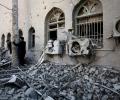
The logic of war plus the gathering storms in US politics as the midterms loom large leave him with no real alternative but to negotiate, points out Ambassador M K Bhadrakumar.

Save yourself a seat on the couch to binge watch these many OTT offerings of the week.

'In such a scenario, Iran could proclaim itself victor, rebuild, re-enforce its diminished regional proxies to further destabilise neighbouring nations and take control of the Persian Gulf and Strait of Hormuz.'

The core issues to be settled -- access to Hormuz, Israel's aggression in Lebanon, the question of Iran's nuclear programme, sanctions relief and compensation -- are thorny enough to require weeks of patient negotiation. The most likely outcome of the opening sessions is that both sides take the measure of each other, establish what is and is not negotiable, and return home without having broken anything. That would count as progress.

Taking Kharg would give the US control over virtually all of Iran's oil exports and thus provide significant leverage, notes Prem Panicker in his must read daily blog on the Gulf War. It would also put American troops within range of Iran's remaining missiles, drones, and artillery on a piece of real estate that is just eight square miles in size, and just 15 miles from the Iranian mainland.

Neal Katyal, an accomplished Indian-American lawyer, triumphed in a landmark Supreme Court case against Donald Trump's tariffs, championing the Constitution and the rights of American small businesses.

Iran is fighting a different war: Older, slower, and in some ways more dangerous. Iran doesn't need to shoot down an F/A-18. It only needs to make the Strait of Hormuz feel dangerous long enough for insurance markets, shipping companies, and oil futures traders to do the rest. Prem Panicker continues his must-read daily blog on the war in the Middle East.

For weeks, the war skirted the edge of catastrophe without tipping over. Missiles flew, there was much destruction, commanders were assassinated, cities across the Gulf and even in Israel struggled to absorb the shock. But one line held: Energy infrastructure, the arteries of the global economy, remained largely untouched. That is no longer true. Prem Panicker continues his must read daily blog on the Gulf War.

'We need to give Pakistan something serious to think about on its eastern front -- that is the only way to actually help Afghanistan right now.'

Israel and the United States had a plan. Iran punched back. And now the Gulf is reeling, the world is beginning to feel the pain and, as on date, no one in Washington or Tel Aviv appears willing to admit that the punch has landed, notes Prem Panicker, continuing his must-read blog on the war in the Middle East.

US-Israel air attacks intensified on the seventh day of war, striking Tehran and other Iranian cities.

The question is no longer whether the war will expand. It has. The next few days will tell us whether the war stabilises around Hormuz or whether the Strait itself becomes the trigger for a far larger rupture. What to watch for over the next 48 hours is simple: Any move by the US toward direct naval control of the Strait; any credible Iranian attempt to disrupt or mine shipping lanes and, critically, whether energy infrastructure in the Gulf continues to be targeted.If those lines are crossed in tandem, the war will no longer be containable within the region.
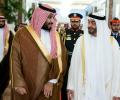
What began as a mentor-protege relationship between UAE President Mohammed bin Zayed and Saudi Crown Prince Mohammed bin Salman has now evolved into a broader contest over influence, strategy, and leadership in the Middle East, points out Asif Ullah Khan.

Alliances fight wars effectively only when they share an endgame. If Israel acted without US knowledge, then the military alliance is operating without real coordination at the level of strategic targeting. Neither picture is reassuring in a war that is no longer regional in its consequences. Prem Panicker continues his must read daily blog on the Gulf War.
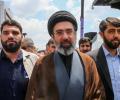
'Mojtaba Khamenei supervised the most recent repression in December 2025 and January 2026 which remains ongoing.'

When everyone has footage and no one can verify it, the loudest voice wins, notes Prem Panicker who begins a daily blog on the War in the Middle East.

Amar Subramanya's appointment comes as John Giannandrea, Apple's senior vice-president for machine learning and AI Strategy, prepares to step down, transitioning to an advisory role before retiring in spring 2026.

'China continues to perceive its relations with India through the prism of India-US relations, with the US using India to counter balance against China in the Indo-Pacific and beyond.'

Physical activities such as bending and pushing may temporarily flare up lower back pain but are unlikely to cause long-term damage, a new study has found.

Aseem Chhabra lists his top 10 films from this year's Sundance festival, a blend of narratives and documentaries made in the US and other parts of the world.

'After the Galwan clash, the rules of engagement changed with the army commanders allowed to use any means at their disposal as they deem fit for tactical operations.'
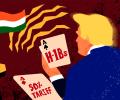
Nineteen United States states have sued the Trump administration over its 'unlawful' decision to impose a $100,000 fee on new H-1B visa petitions, warning that the move will worsen labour shortages in key sectors such as health care, education and technology.

'The tools of warfare are changing. The MoD must deepen its engagement with technology thinkers that can present compelling visions of where warfare may be heading.'

Left parties on Saturday denounced the United States for attacking Venezuela and capturing its President Nicholas Maduro, with Communist Party of India-Marxist general secretary M A Baby terming the nighttime military action an 'act of international terrorism by US-led imperialism'.

Trump has been critical of Mamdani's policies and had warned on the eve of the November 4 election that Mamdani's win will be a "complete and total economic and social disaster" for New York City.
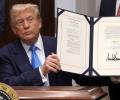
For India, the challenge is to strike a balance between tactical necessity and economic priorities, point out Pravin Krishna and Monil Sharma.

Several Indian-American and South Asian candidates are running for key positions in the US elections, including mayoral and gubernatorial races.

Sanctioning Russian oil would have led to a sharp surge in oil prices to above $80 per barrel levels, which would impact pump prices in the US ahead of midterm elections next year.

How the UN's flagship climate summit lost its direction and what's at stake.

According to the Justice Department, Tellis, 64, the Tata Chair for Strategic Affairs and a senior fellow at the Carnegie Endowment think-tank, served as an unpaid senior adviser to the State Department and was also a contractor with the Office of Net Assessment at the Department of Defense.

While Zohran Mamdani captured national attention with his meteoric rise to be elected New York City's first Muslim mayor, his wife Rama Duwaji was helping orchestrate his win -- one pixel, one brushstroke, one brand decision at a time.

Amit Kshatriya, a decorated Indian-American and NASA veteran, has been appointed as NASA's new associate administrator, marking a significant step in the agency's exploration efforts.

'India has the deciding vote in the 21st century...India is a significant player in the 21st century and is poised to become even more powerful.'
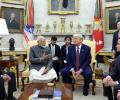
'As one former Indian diplomat put it to me, Delhi has access to the White House, but Islamabad has access to Mar-a-Lago.'

'Pakistan is an ally who gives the US access.' 'If we have a presence there, it puts us that much closer to China and puts our assets closer to China and Iran.'

'Trump has personally weighed in to overcome doubts and reservations about Pakistan among his top advisors.'
